
- Home
- About
- Programs
- Future Students
- Current Students
- How to Apply

R U OK? Day, held on 10 September, is a reminder that asking someone how they are can be the beginning of an important conversation. But knowing how to start that conversation isn’t always easy.
For R U OK? Day, Bernadette, a third-year Social Science student at Adelaide University and Eynesbury College alumna, shares her perspective on checking in with friends, recognising when someone might not be okay, and why you don’t need to have all the answers to show someone you care.
Bernadette also spoke with Eynesbury College counsellor Ann Sherwell about supporting friends and knowing when it might be time to encourage someone to seek professional support.
Every day as students, we see our friends in class, around campus, at work or grabbing a coffee between lectures. We become familiar with their personalities, their smiles and the way they usually behave.
So, when something changes, we often notice.
Maybe a friend is quieter than usual. Maybe they’re sitting alone, looking down or simply not smiling as much as they normally do.
We might notice these small changes, but still feel nervous about asking: “Are you okay?”
We might worry that we’re being too personal, or that our friend will feel uncomfortable. We might be afraid they’ll open up and we won’t know what to say.
Sometimes, we even convince ourselves that they’re probably fine and it’s not our place to ask.
But we don’t need to be a counsellor to check in on someone.
As Social Science students, we’re often taught about communication, empathy and supporting people through difficult situations. But having a conversation about how someone is really feeling can still feel uncomfortable.
And that’s okay.
Students can experience all kinds of pressures, from academic stress and friendship difficulties to financial worries, family responsibilities and uncertainty about the future. Someone might be dealing with something difficult even when they appear to be doing perfectly well.
We often assume that when someone is smiling, they’re happy. But we can’t always know what’s happening beneath the surface.
That’s why checking in can matter.
“Are you okay?”
And if the answer is no, we don’t need to have the perfect response.
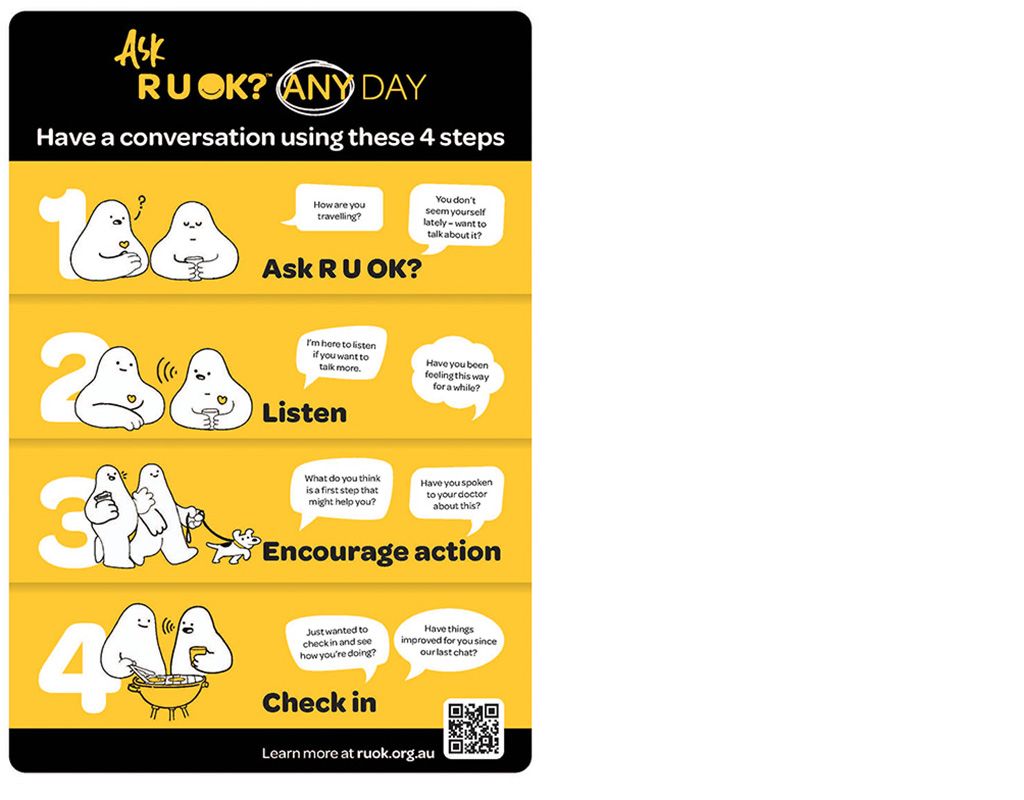
R U OK? encourages a simple four-step approach to checking in with someone: Ask, Listen, Encourage and support, and Follow up.
If you notice that a friend doesn’t seem like themselves, let them know you’ve noticed and ask if they’re okay.
It doesn’t need to be complicated.
“You don’t seem like yourself today. Is everything okay?”
A simple question can open the door to a conversation.
If someone does open up, we can sometimes feel pressure to give advice or find a solution.
But we don’t always need to fix the situation.
Sometimes, giving someone the space to talk and knowing that someone genuinely cares are what they need most.
Eynesbury College counsellor Ann Sherwell says you don’t need to know exactly what to say.
“If a student feels like they don’t have the answer, it’s okay to not know the answer. Instead, they can support their friend to find professional support and be with them as they reach out for help.”
Being there to listen can be more important than having the perfect response.
If your friend is struggling, encourage them to talk to someone they trust or seek professional support.
Importantly, you don’t have to carry the responsibility alone. Being a supportive friend doesn’t mean becoming someone’s counsellor.
At Eynesbury College, students can access counselling if they’re going through a difficult time.
Ann describes the service as a casual and relaxed space where students can drop in when they want to talk. A counsellor can help students unpack what’s happening and work through their situation.
Checking in shouldn’t necessarily end with one conversation.
Send your friend a message the next day, or check in when you see them again.
“Hey, I just wanted to see how you’re going.”
It’s a small thing, but it shows that you genuinely meant it when you said you cared.
As Ann explains:
“Following up with a friend means that you’re concerned and reassuring them that you’re with them and they’re not alone.”
When I was 16 years old, I remember convincing myself that I would smile at every person I saw on the street.
I didn’t know what they were going through or what kind of day they were having. But I thought that if they remembered the smile I shared with them, or the smile they gave back, perhaps it could bring them a small moment of happiness.
That idea has stayed with me.
It reminds me that we never truly know what someone else is going through. We may not always be able to see someone’s struggles, but we can choose to be kind.
Sometimes, that kindness is a smile.
Sometimes, it’s sitting beside someone.
And sometimes, it’s simply asking:
“Are you okay?”
Checking in on a friend doesn’t mean you have to solve their problems. It means showing them that someone cares.
So, the next time you notice that a friend isn’t quite themselves, be brave enough to ask.
Ask. Listen. Encourage and support. Follow up.
Because sometimes, one simple question can open the door to a conversation someone really needed.
If you or someone you know is going through a difficult time, support is available.
Eynesbury College Counselling Service
Eynesbury College offers free and confidential counselling for students experiencing personal, emotional or study-related concerns. You don’t need to be experiencing a major crisis to reach out. Sometimes, you might simply need someone to talk to.
Students can contact the counselling team to make an appointment:
Email: eynesbury.counsellor@navitas.com
Ann Sherwell: 0448 878 943
Leeanne D’arville: 0491 052 487
Students can also visit the Student Counsellor’s office at the Coglin Street campus or ask Student Services for assistance.
R U OK?
R U OK? provides practical advice on how to recognise when someone might be struggling and how to have a meaningful conversation.
Learn more about the four steps: Ask, Listen, Encourage action and Check in.
Beyond Blue
Beyond Blue provides information and support for people experiencing anxiety, depression or other mental health concerns.
1300 22 4636 | Available 24/7
Lifeline
If you need immediate emotional support or someone to talk to, Lifeline is available 24 hours a day.
13 11 14 | Available 24/7
Eynesbury College’s counselling service is not a 24-hour crisis service.
If you or someone else is in immediate danger, call 000.
For urgent mental health support in South Australia, you can also contact Mental Health Triage on 13 14 65, available 24 hours a day.
Remember: asking for help is a strength. You don’t have to have everything figured out before you reach out.
Editor’s Note: This article is based on on an original piece by Bernadette Perera, developed as part of Eynesbury College’s Content Squad initiative. Bernadette’s reflections and personal perspective form the heart of the article, with editorial input and contributions from Eynesbury College staff. The Content Squad gives students the opportunity to gain hands-on experience in content creation, marketing and communications while sharing their unique perspectives and experiences.